Over the past decade, the rise of e-commerce and evolving supply chain dynamics drove significant shifts in industrial real estate demand. In the mid-2010s, the need for fast delivery to individual consumers and businesses made convenient locations and particular construction features even more desirable.
But just how important were those characteristics in determining an industrial property’s rent growth? Are they as important now as they were then? And what new factors might be important in the future?
Leveraging a unique, granular data set from Cred iQ that includes detailed property-level historical financial statements for all properties that ever have utilized commercial mortgage-backed securities (CMBS) for leverage, we have identified the building and location characteristics that influence warehouse rents and how their importance has changed over time. Our analysis shows that previously difficult‑to‑measure factors, including population density, proximity to logistics nodes and building age, have accounted for roughly one‑third of asset rents since 2010, with variation across markets. The remaining rent levels are driven by traditional factors such as market conditions, lease terms and credit quality.
Three of the top rent drivers — location near population centers, location near highway ramps and other key logistics nodes, and building age — grew sharply during the rise in e-commerce and have since stabilized, which allows for more accurate forecasting. We will detail these trends, as well as how we think industrial rent drivers could shift in the future.
MetLife Investment Management, utilizing data from CRED iQ, compiled a comprehensive dataset of financial statements and physical characteristics of 3,382 U.S. industrial facilities that borrowed in CMBS markets and had at least three years of performance data. More specifically, we examined the quarterly gross revenue and rent rolls these borrowers submitted to their lenders, which were then standardized by CMBS servicers. While this data does not capture the entire industrial real estate universe, it represents a robust sample of stabilized institutional-quality assets.
We supplemented the data with Freight Analysis Framework (FAF) logistics data from the U.S. Department of Transportation and demographic information from the U.S. Census Bureau’s American Community Survey. By integrating these sources, we analyze how specific traits impact industrial rents and how these relationships evolved over time.
1. Density Premium
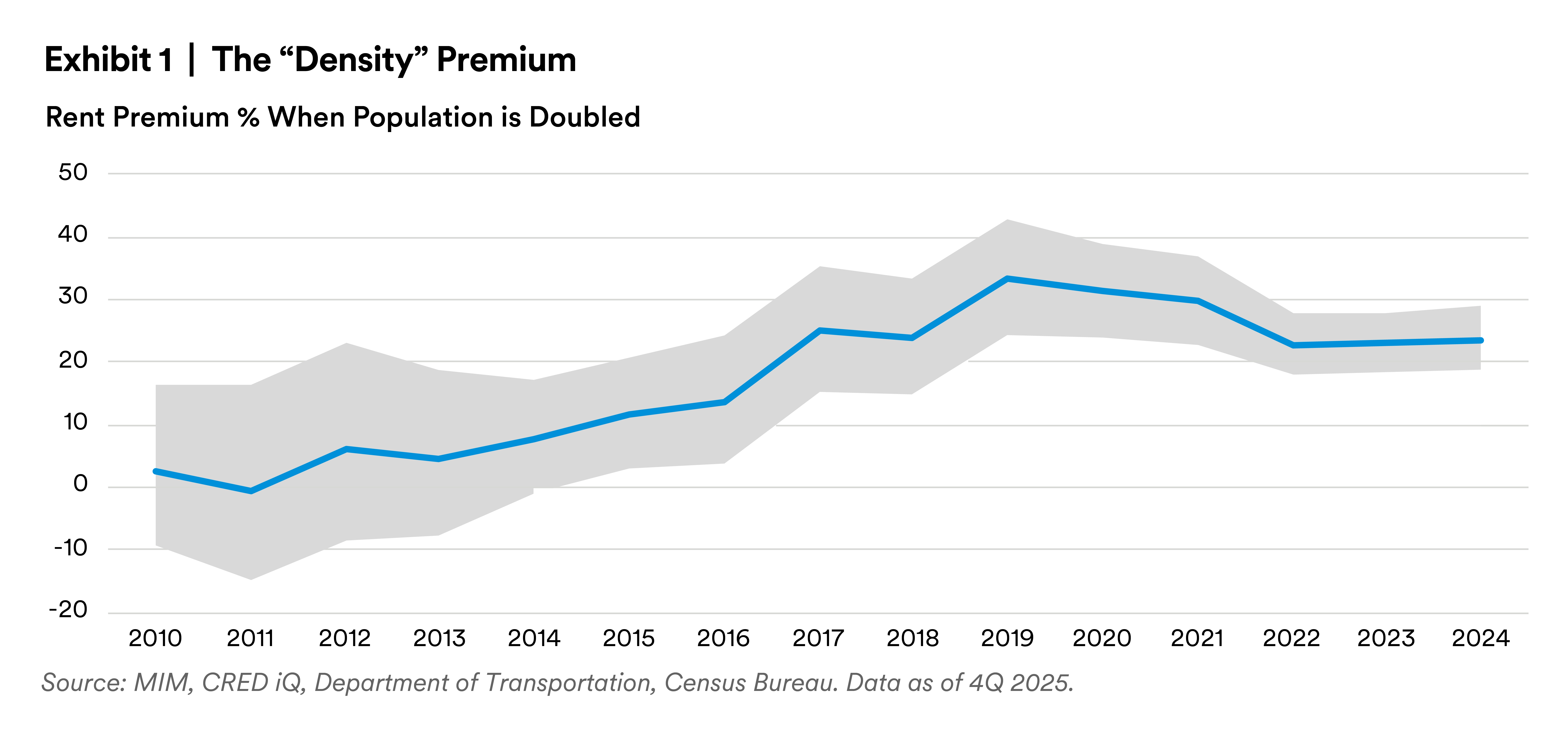
Proximity to population centers, which we call the "density premium," had the greatest effect on industrial rents in our study. Warehouses located in more densely populated areas command higher rents because land values are higher and proximity to large consumer markets provides a strategic advantage for shippers. This relationship may seem intuitive, but the density premium has changed over time.
The line in the chart below represents the change in rent levels given the number of residents in a five-mile radius of a warehouse. The shaded areas around the line represent a confidence interval around that estimate. The density premium was less significant in the early 2010s — note that the confidence interval contains both positive and negative values. This began to change in 2014 as e-commerce activity accelerated, and tenants increasingly prioritized delivery speed. This trend continued through 2022; growth in the density premium has now leveled off, though absolute levels remain elevated compared to history.
2. Transportation Access Premium
Proximity to highway infrastructure and logistics nodes are another significant driver of rental rates. Highway access is moderately correlated with click‑to‑door speed, as compared to our population density analysis, and is likely influenced by factors such as labor and energy costs that feed into shipping costs.
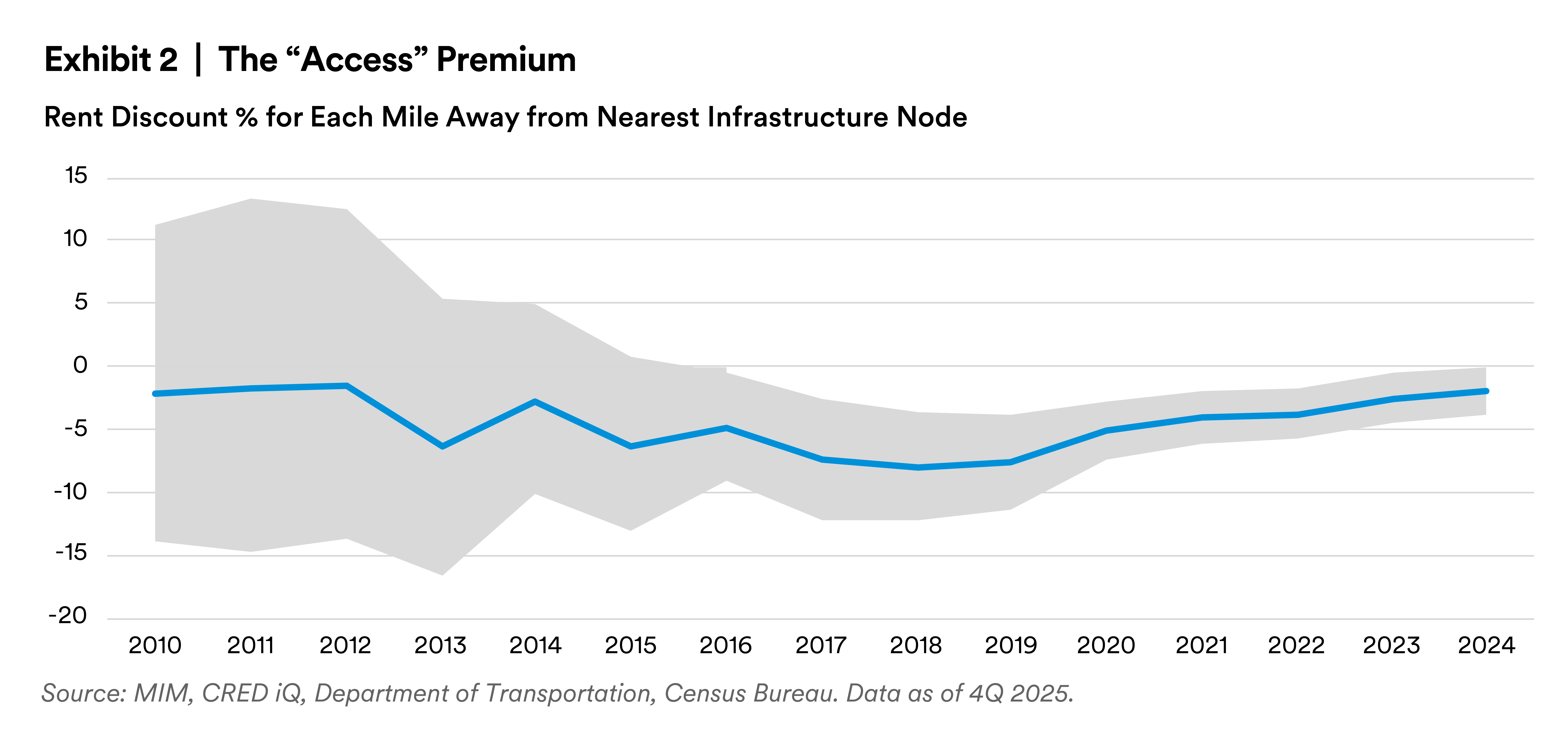
For this analysis, we evaluated location-specific details on highway access ramps and logistics nodes like airports or seaports contained in the Transportation Sector’s Freight Analysis Framework (FAF) data. Our analysis found that rents decline by approximately 2% on average for every additional mile between a warehouse and a highway ramp.
The transportation access premium has followed a similar trajectory to the density premium. It became increasingly important after 2016, coinciding with the expansion of Amazon’s logistics network and the proliferation of e-commerce fulfillment requirements such as one-day delivery. In recent years, its influence has noticeably declined, though it remains significant in determining potential rents. We think these trends reflect both a slowdown in last-mile distribution growth and an increasing trade-off between cost and proximity for logistics providers.
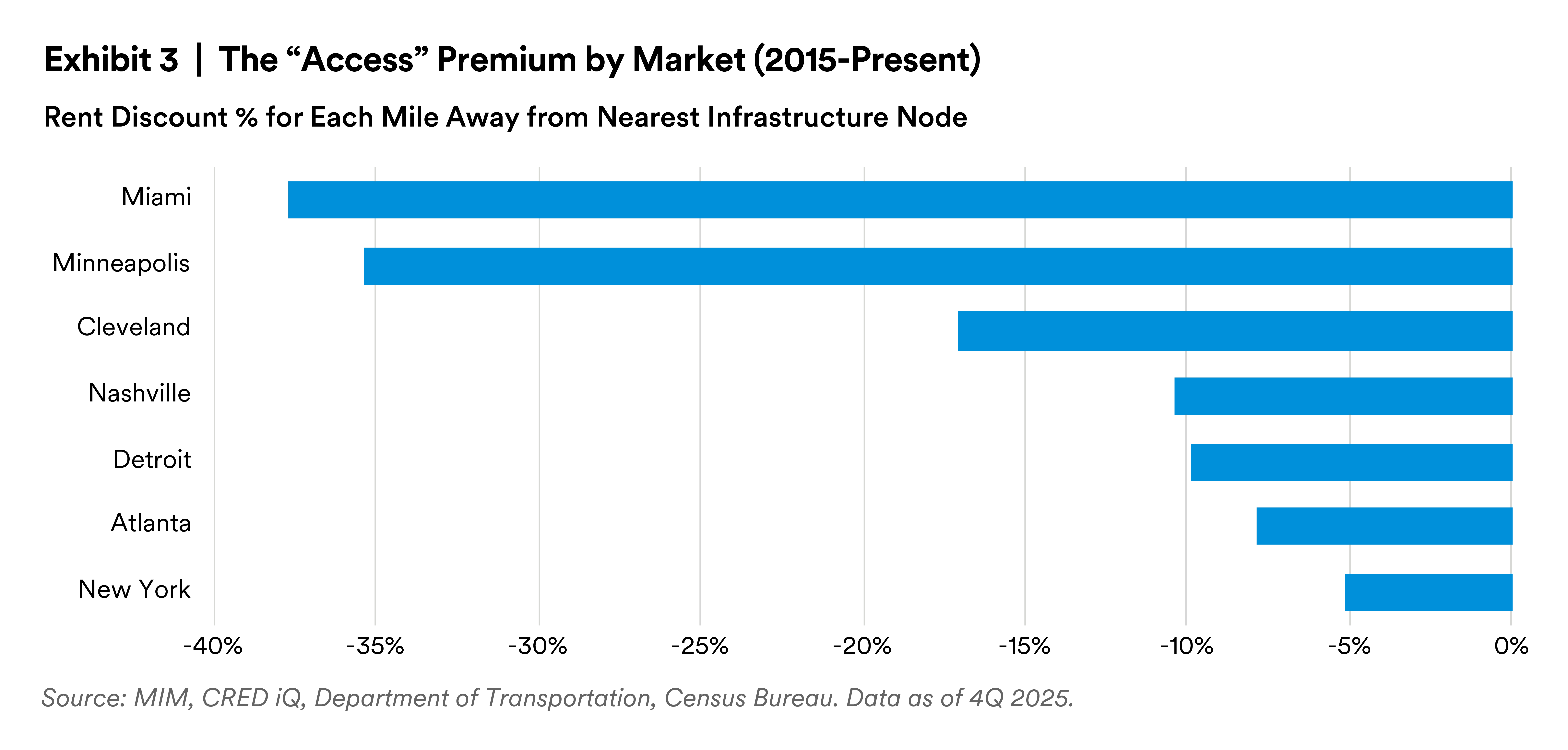
The transportation access premium varies considerably across markets. In Miami, Minneapolis and Cleveland, proximity to highway ramps translated into the largest rent differentials. In contrast, several markets showed no statistically significant access premium.
3. Age Premium
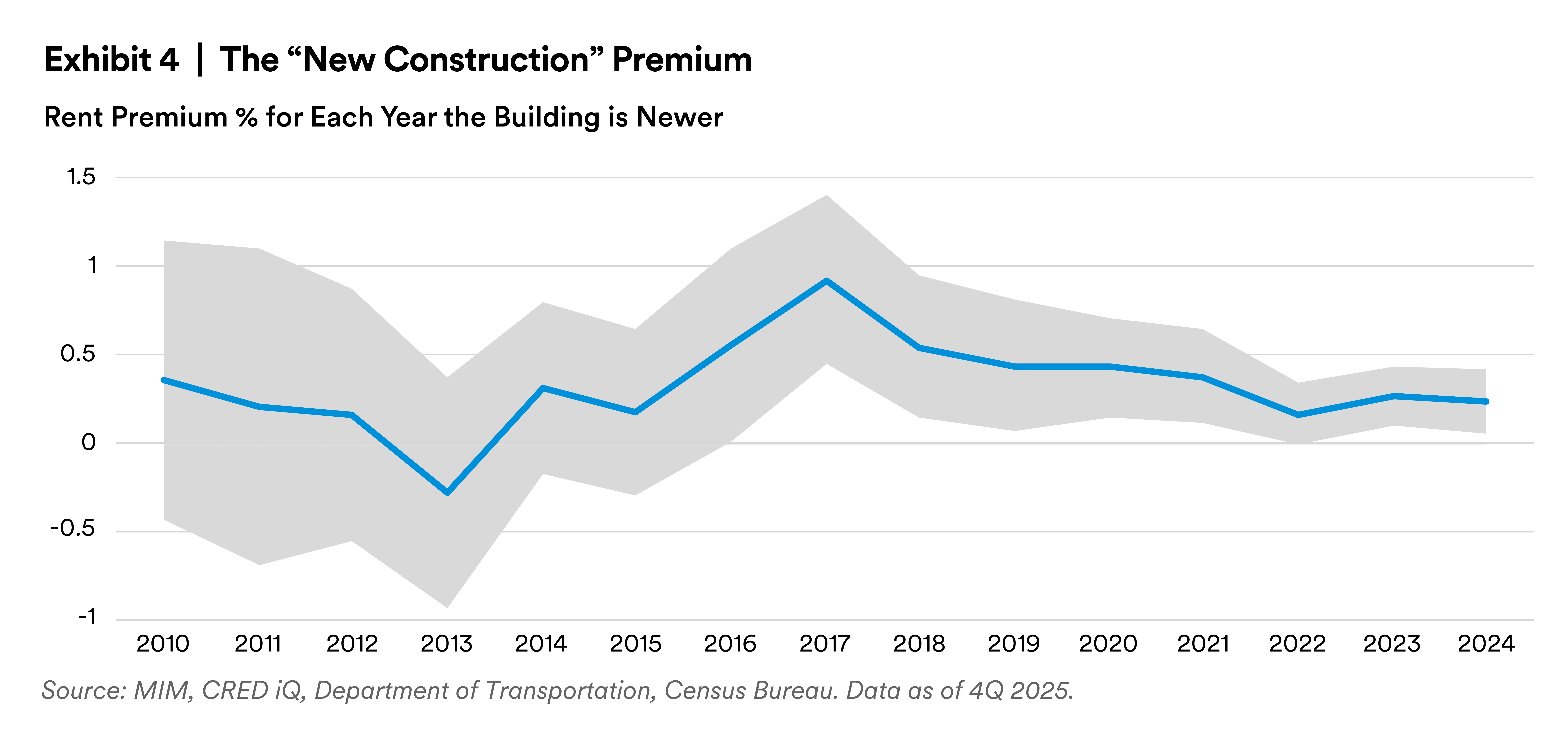
Building age also plays a role in determining industrial rents. Modern industrial tenants expect features like elevated clear heights that support racking, wider column spacing that allows for flexibility in layouts and automation, thick floor slabs with high load ratings, modern dock door configurations, and modern fire and other safety features. We controlled for these factors to isolate the location and access premiums.
When we looked at facility age in isolation, however, we saw that it is a less important driver than either population density or highway access. While modern facilities are desirable, location remains the dominant driver of rental performance. The declining age premium may be driven by the large number of modern industrial facilities that have come onto the market over the past five to ten years.
A granular understanding of historical rent changes leaves us well positioned to forecast the future. Infill industrial assets were winners for most of the last 15 years, primarily due to the growth in e-commerce and the push for faster delivery speeds. As of 2026, major logistics operators appear to have reached an equilibrium in what they can profitably pay for access to logistics nodes and population centers. The location premium is no longer expanding and, in some cases, has modestly declined from the peak expansion days of the late 2010s and COVID era. As a result, infill warehouses may not outperform regional distribution hubs this cycle. Underwriting similar rent growth across both infill and regional categories may be the optimal approach, unlike the prior cycle when underwriting faster rent growth for infill assets was the right strategy.
For core assets, this means that selecting the right cities may dominate alpha generation this cycle, whereas last cycle selecting the right submarkets within a city was a larger driver of performance. While submarket selection remains a key source of potential outperformance — especially in markets with high variability between submarkets — its relative importance has diminished.
For developers, these findings provide a framework for triangulating achievable starting rents for new construction in the absence of perfect comparables and for optimizing site selection based on both access to logistics nodes and population centers. New geospatial tools like CRED iQ’s property-level dataset offer a more granular perspective on property performance, giving investors a new source of alpha generation.
Looking ahead, several macro and technological trends could reshape the sector over the next 5-10 years. The Federal Aviation Administration is expected to finalize drone delivery rules in 2026, which will likely accelerate the adoption of autonomous delivery and robotics. As these technologies become mainstream, the strategic advantage of proximity to dense population centers and highway ramps may diminish, pushing last-mile and small-package fulfillment to suburban and suburban fringe areas. This could shift value toward facilities with robust power access, advanced automation infrastructure and flexible layouts that can accommodate new technologies. Examples of desirable power access include dedicated utility substations for large-scale robotics, onsite microgrids or battery storage to support automation and EV charging, and smart energy management systems that ensure both reliability and cost-efficiency. Modern warehouses with these features are already seeing increased tenant demand, especially from e-commerce operators, automotive suppliers and data centers with high electric loads.
At the same time, the next economic downturn will test the sector’s resilience. Industrial real estate has not yet experienced a severe recession in the current e-commerce era. While core, supply-constrained assets serving essential industries are likely to remain robust, investors should stress-test portfolios for cyclical risk and focus on assets with diversified tenant bases and long-term leases. Attributes that aid economic resilience at the asset level include a diversified tenant mix — logistics, manufacturing and e-commerce — along with long-term, triple-net leases that stabilize cash flow and proximity to major logistics nodes such as ports and airports. Facilities in infill locations with multi-tenant profiles tend to better withstand market turbulence. In addition, infill sites in markets with land scarcity and restrictive zoning will likely fare better, since barriers to new supply can support rents even if overall demand softens.
Finally, supply constraints and new demand drivers such as onshoring, nearshoring and increased domestic manufacturing are expected to support rent growth for well-located assets, even as premiums for infill and access moderate. U.S. manufacturing construction has surged in response to reshoring initiatives, driving demand for industrial sites near production facilities and cross-border logistics nodes, particularly in the Midwest and Sunbelt. The rise of EV battery plants and hyperscale data centers is also increasing competition for industrial-zoned land and robust power infrastructure, especially in regions like Texas and the Great Lakes. At the same time, utility grid delays are making sites with existing heavy power connections even more valuable, as new projects can be delayed by transformer shortages or limited local capacity. Investors should prioritize assets with expandable power infrastructure and proximity to both labor and transportation networks.
In summary, while population density, highway access and building age will remain important, the most resilient and sought-after assets going forward are likely to be those that are technologically adaptable, able to withstand economic cycles and positioned to benefit from supply constraints and shifting demand patterns, such as onshoring and electrification. Modern resilience and utility are defined not just by location, but by adaptability and infrastructure. A forward-looking, data-driven approach will be essential for identifying and capitalizing on these evolving opportunities.
Disclosure
This material is intended solely for Institutional Investors, Qualified Investors and Professional Investors. This analysis is not intended for distribution with Retail Investors.
MetLife Investment Management (MIM), which includes PineBridge Investments, is MetLife Inc.’s institutional investment management business. MIM is a group of international companies that provides investment advice and markets asset management products and services to clients around the world.
This document is solely for informational purposes and does not constitute a recommendation regarding any investments or the provision of any investment advice, or constitute or form part of any advertisement of, offer for sale or subscription of, solicitation or invitation of any offer or recommendation to purchase or subscribe for any securities or investment advisory services. The views expressed herein are solely those of MIM and do not necessarily reflect, nor are they necessarily consistent with, the views held by, or the forecasts utilized by, the entities within the MetLife enterprise that provide insurance products, annuities and employee benefit programs. The information and opinions presented or contained in this document are provided as of the date it was written. It should be understood that subsequent developments may materially affect the information contained in this document, which none of MIM, its affiliates, advisors or representatives are under an obligation to update, revise or affirm. It is not MIM’s intention to provide, and you may not rely on this document as providing, a recommendation with respect to any particular investment strategy or investment. Affiliates of MIM may perform services for, solicit business from, hold long or short positions in, or otherwise be interested in the investments (including derivatives) of any company mentioned herein. This document may contain forward-looking statements, as well as predictions, projections and forecasts of the economy or economic trends of the markets, which are not necessarily indicative of the future. Any or all forward-looking statements, as well as those included in any other material discussed at the presentation, may turn out to be wrong.
The various global teams referenced in this document, including portfolio managers, research analysts and traders are employed by the various legal entities that comprise MIM.
All investments involve risks including the potential for loss of principle and past performance does not guarantee similar future results.
For investors in the U.S.: This document is communicated by MetLife Investment Management, LLC (MIM, LLC), a U.S. Securities and Exchange Commission (SEC) registered investment adviser. Registration with the SEC does not imply a certain level of skill or that the SEC has endorsed the investment adviser.
For investors in the UK: This document is being distributed by MetLife Investment Management Limited (“MIML”), authorised and regulated by the UK Financial Conduct Authority (FCA reference number 623761), registered address One Angel Lane 8th Floor London EC4R 3AB United Kingdom. This document is approved by MIML as a financial promotion for distribution in the UK. This document is only intended for, and may only be distributed to, investors in the UK who qualify as a "professional client" as defined under the Markets in Financial Instruments Directive (2014/65/EU), as per the retained EU law version of the same in the UK.
For investors in the Middle East: This document is directed at and intended for institutional investors (as such term is defined in the various jurisdictions) only. The recipient of this document acknowledges that (1) no regulator or governmental authority in the Gulf Cooperation Council (“GCC”) or the Middle East has reviewed or approved this document or the substance contained within it, (2) this document is not for general circulation in the GCC or the Middle East and is provided on a confidential basis to the addressee only, (3) MetLife Investment Management is not licensed or regulated by any regulatory or governmental authority in the Middle East or the GCC, and (4) this document does not constitute or form part of any investment advice or solicitation of investment products in the GCC or Middle East or in any jurisdiction in which the provision of investment advice or any solicitation would be unlawful under the securities laws of such jurisdiction (and this document is therefore not construed as such).
For investors in Japan: This document is being distributed by MetLife Investment Management Japan, Ltd. (“MIM JAPAN”), a registered Financial Instruments Business Operator (“FIBO”) conducting Investment Advisory Business, Investment Management Business and Type II Financial Instruments Business under the registration entry “Director General of the Kanto Local Finance Bureau (Financial Instruments Business Operator) No. 2414” pursuant to the Financial Instruments and Exchange Act of Japan (“FIEA”), and a regular member of the Japan Investment Advisers Association and the Type II Financial Instruments Firms Association of Japan. In its capacity as a discretionary investment manager registered under the FIEA, MIM JAPAN provides investment management services and also sub-delegates a part of its investment management authority to other foreign investment management entities within MIM in accordance with the FIEA. This document is only being provided to investors who are general employees' pension fund based in Japan, business owners who implement defined benefit corporate pension, etc. and Qualified Institutional Investors domiciled in Japan. It is the responsibility of each prospective investor to satisfy themselves as to full compliance with the applicable laws and regulations of any relevant territory, including obtaining any requisite governmental or other consent and observing any other formality presented in such territory. As fees to be borne by investors vary depending upon circumstances such as products, services, investment period and market conditions, the total amount nor the calculation methods cannot be disclosed in advance. All investments involve risks including the potential for loss of principle and past performance does not guarantee similar future results. Investors should obtain and read the prospectus and/or document set forth in Article 37-3 of Financial Instruments and Exchange Act carefully before making the investments.
For Investors in Hong Kong S.A.R.: MetLife Investment Management and PineBridge Investments operate through the following entities: MetLife Investments Asia Limited (“MIAL”), licensed by the Securities and Futures Commission (“SFC”) for Type 1 (dealing in securities), Type 4 (advising on securities) and Type 9 (asset management) regulated activities, PineBridge Investments Asia Limited licensed by the SFC for Type 1 (dealing in securities), Type 4 (advising on securities) and Type 9 (asset management) regulated activities, and PineBridge Investments Hong Kong Limited licensed by the SFC for Type 1 (dealing in securities) and Type 9 (asset management) regulated activities. PineBridge Investments Asia Limited is registered as a Class A Registered Person with the Bermuda Monetary Authority pursuant to the Investment Business Act 2003 (as amended).
Unless otherwise stated, none of the authors of this article, interviewees or referenced individuals are licensed by the SFC to carry on regulated activities in Hong Kong S.A.R. The information contained in this document is for information purposes only and it has not been reviewed by the Securities and Futures Commission.
This document may also be distributed by PineBridge Investments, LLC and its affiliates acquired by MetLife Investment Management on December 30, 2025. For additional PineBridge legal and regulatory disclosures including other cross border information, please refer to https://www.pinebridge.com/en/regulatory-disclosure.
For investors in Australia: This information is distributed by MIM LLC and is intended for “wholesale clients” as defined in section 761G of the Corporations Act 2001 (Cth) (the Act). MIM LLC exempt from the requirement to hold an Australian financial services license under the Act in respect of the financial services it provides to Australian clients. MIM LLC is regulated by the SEC under US law, which is different from Australian law.
For investors in the EEA: This document is being distributed by MetLife Investment Management Europe Limited (“MIMEL”), authorised and regulated by the Central Bank of Ireland (registered number: C451684), registered address 20 on Hatch, Lower Hatch Street, Dublin 2, Ireland. This document is approved by MIMEL as marketing communications for the purposes of the EU Directive 2014/65/EU on markets in financial instruments (“MiFID II”). Where MIMEL does not have an applicable cross-border licence, this document is only intended for, and may only be distributed on request to, investors in the EEA who qualify as a “professional client” as defined under MiFID II, as implemented in the relevant EEA jurisdiction. The investment strategies described herein are directly managed by delegate investment manager affiliates of MIMEL. Unless otherwise stated, none of the authors of this article, interviewees or referenced individuals are directly contracted with MIMEL or are regulated in Ireland. Unless otherwise stated, any industry awards referenced herein relate to the awards of affiliates of MIMEL and not to awards of MIMEL.