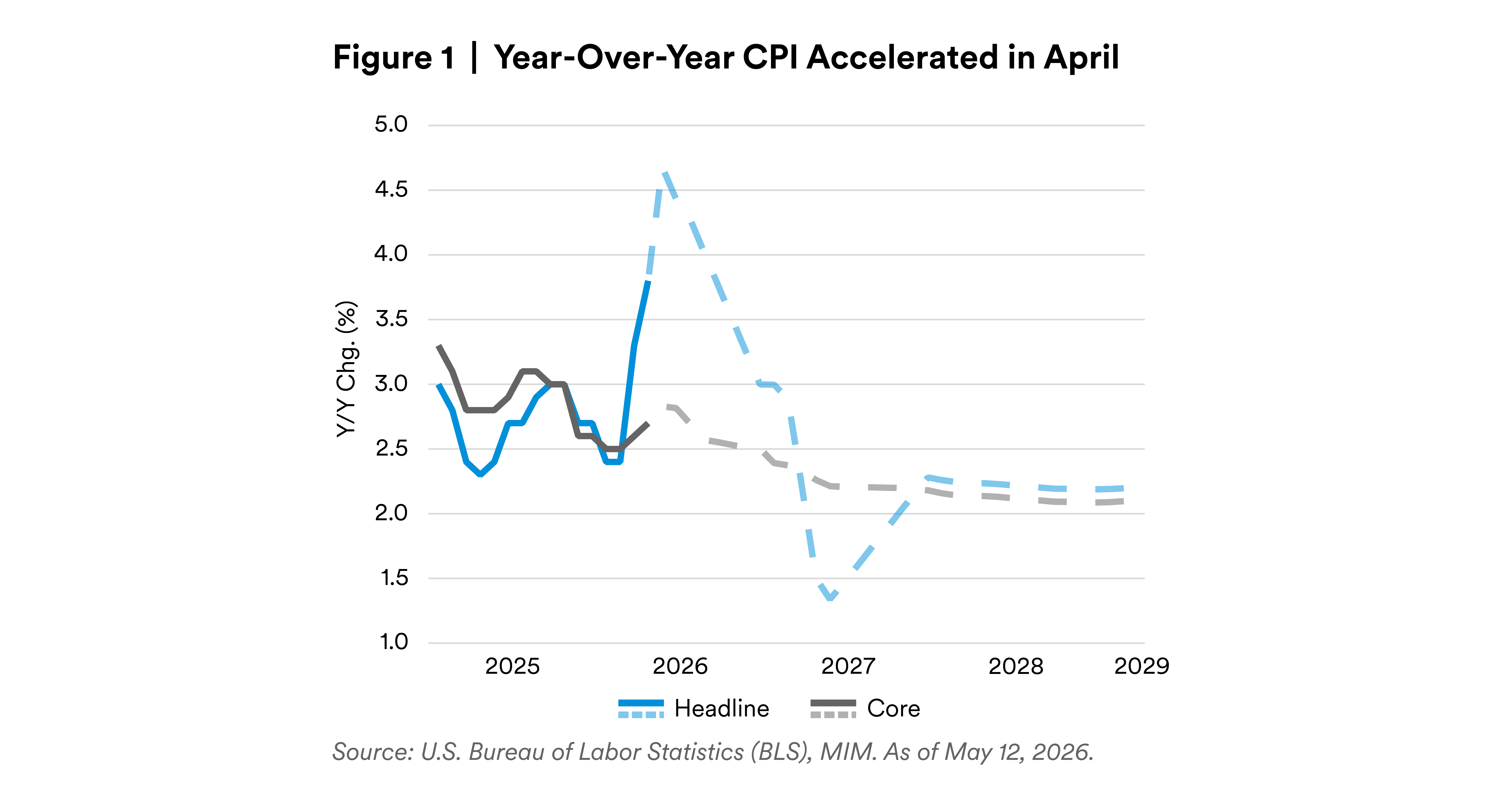
High energy prices brought year-over-year headline inflation to 3.8% in April, up from 3.3% in March. Energy prices were responsible for over 40% of the headline increase.
Core CPI came in at 2.7%, remaining only modestly affected by the energy price effects. Core CPI rose by 0.4%, month on month in April, but approximately 0.1% was attributable to a data artifact left over from the shutdown in October.
Goods inflation is not showing many tariff effects and remains subdued, despite the price indexes for furniture and personal care items showing one of the bigger increases this month.
The Middle East conflict exacerbates near-term inflation issues while adding new ones, somewhat reducing the likelihood of the Federal Reserve cutting rates this year, even as Kevin Warsh starts his tenure.
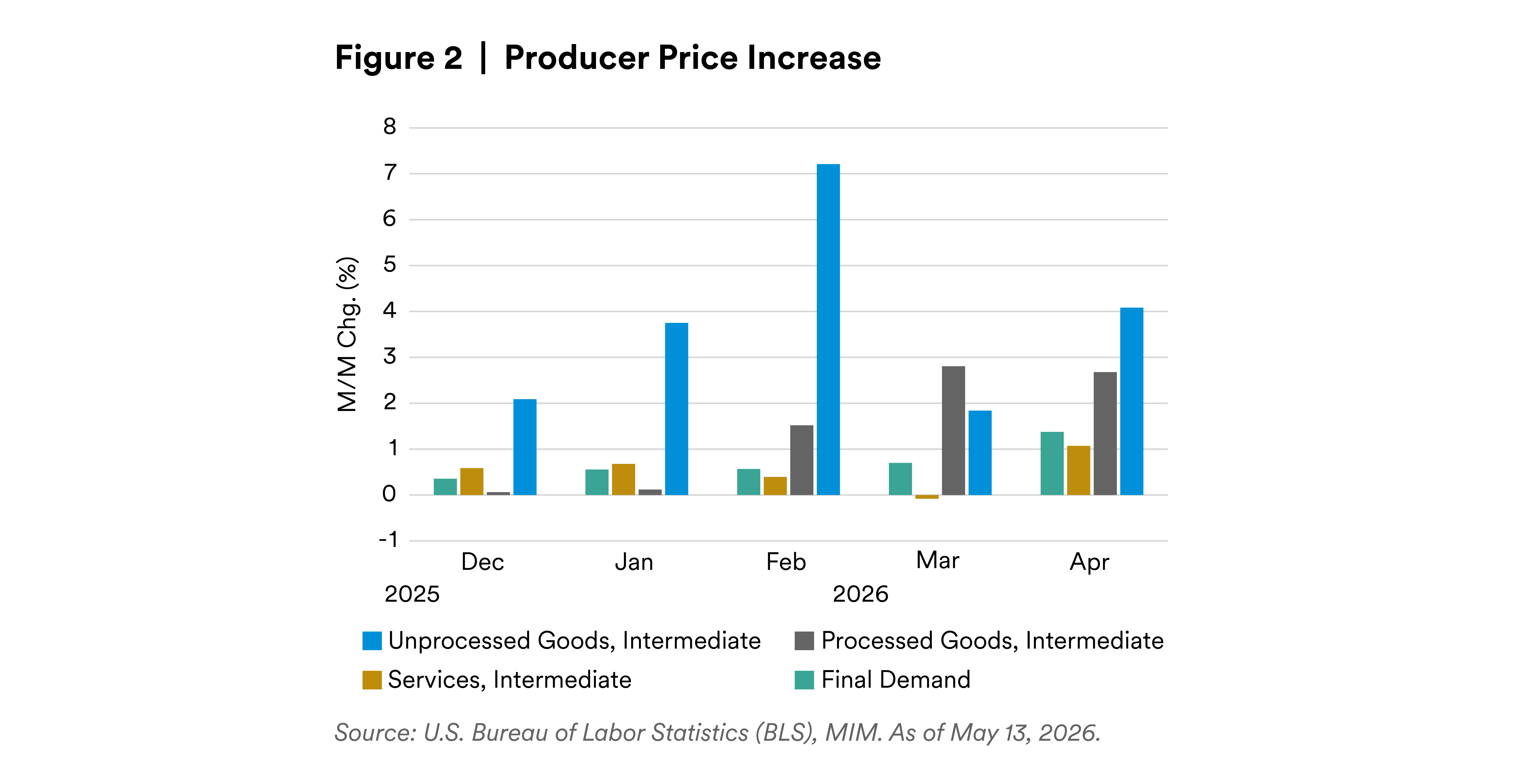
PPI increased 1.4%, month-over-month in April, and is up 6.0% over the year. Core PPI increased 0.6%, the biggest increase since October 2025. Similar to the case with consumer inflation, there is a risk that these inflation pressures will remain for the next few months.
The biggest price increases were in unprocessed goods firms, which include raw materials. Downstream sectors saw less inflation, meaning that firms higher up in the supply chain have not (yet) passed along all their cost increases. Final demand firms are not immune from cost increases, however, and faced a 7.8% price increase for final demand energy. On the services side, truck transportation and fuel and lubricant retailers are feeling price pressures as well.
Producer prices will be important to watch even as the oil shock fades. Even though there are cases, such as in March 2026, when PPI increased less than expected, businesses are facing increasing costs overall. After falling rapidly in 2022, PPI has been rising steadily since 2023. Today, headline PPI is at 6%, year over year, and core PPI is at 4.4%, year over year. But in April 2023, headline PPI was at 2.3%, year over year, and core PPI was at 3.1%, year over year.
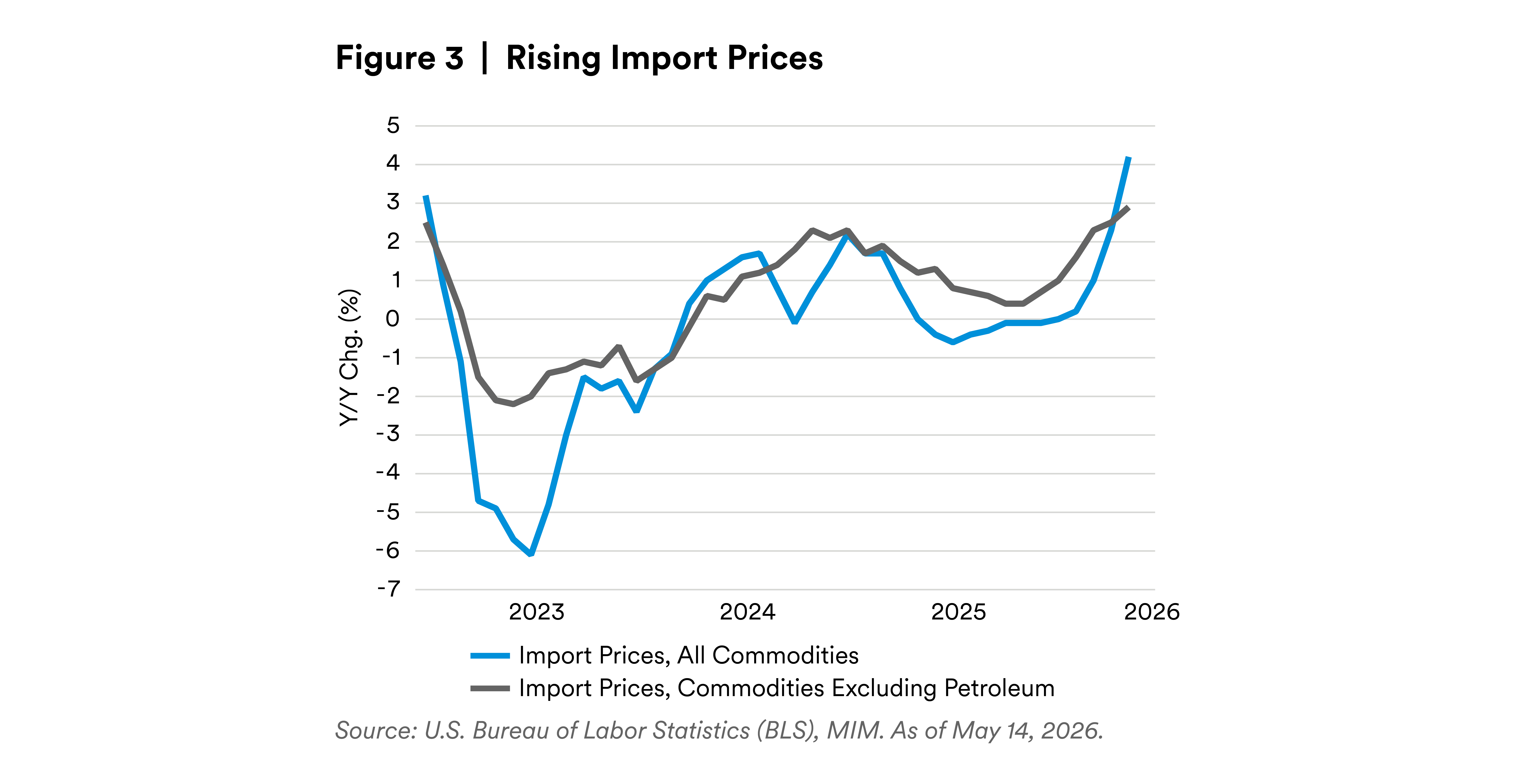
Import prices increased 1.9%, month over month in April, bringing the annual increase to 4.2%, year over year, a rate of increase last seen in October 2022. Import prices were affected by fuel and energy imports, but prices excluding fuel still rose 0.8% over the month and are up 2.9%, year over year.
The two biggest categories of increase were industrial supplies and materials, which increased 13.1%, year over year in April, and capital goods, which increased 4.6%, year over year in April.
Similar to the case with producer inflation, import prices fell rapidly after 2023, but are important to watch because they have been moving in the opposite direction for years since then. The Middle East conflict created a distinct spike due to energy costs, but prices have now moved from a sharp deflation of 6% in 2023 to a 4% increase today.
And just as with consumer and producer inflation, the spike in import price inflation is likely to take months to resolve, at minimum.
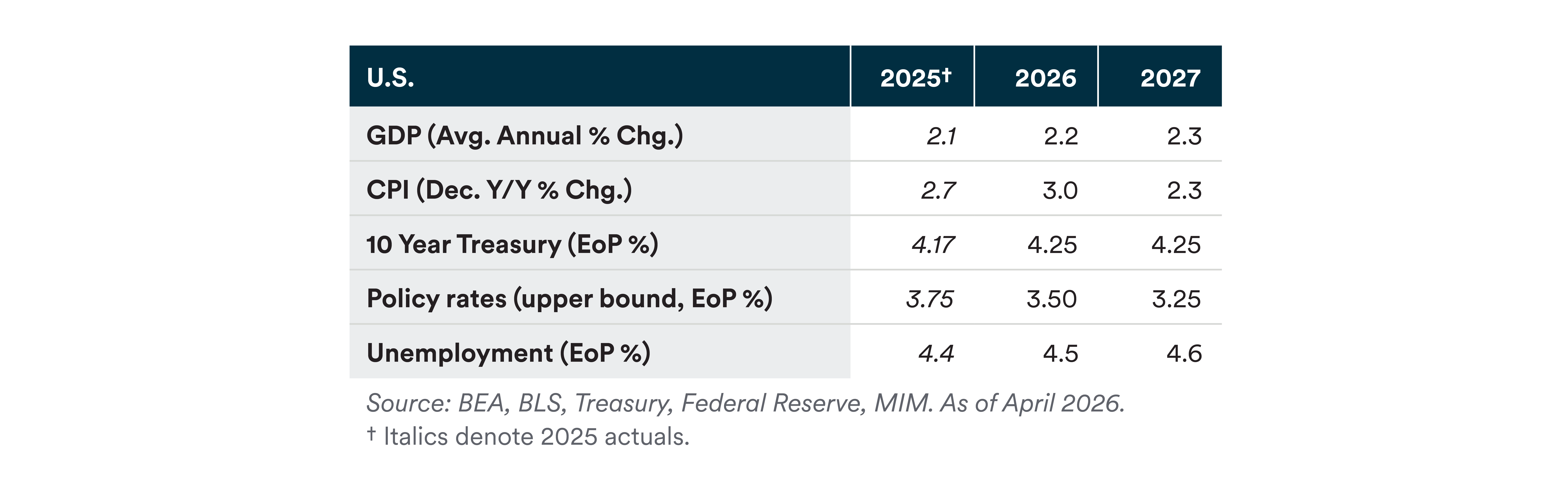
We expect 2026 GDP growth to be roughly in line with 2025, driven by moderate consumption and solid non-residential investment. We expect net exports to remain strong, as U.S. businesses try to shift away from import-driven businesses. The conflict in the Middle East has dominated recent headlines. We believe the oil price shock will drive up inflation only in the short run, so our overall 2026 inflation forecast has been revised upward to 3.0% from 2.6%. We believe labor demand will remain lackluster in 2026, meaning the labor market, while balanced, is vulnerable to shocks.
Given that both sides of the Fed’s mandate are under threat, and uncertainty is greater than it was some months ago, our base case is that the Fed will only cut rates once this year. The timing of additional rate cuts would be pushed back into 2027. We do not believe the current oil price shock warrants a hike, as the shock is temporary and unlikely to affect core inflation much more than it already has. However, if high oil prices continue to push up producer and consumer inflation, the likelihood of rates staying constant is significantly higher.
The biggest risk to our forecast comes from the conflict with Iran and the continued closure of the Strait of Hormuz. While we have revised our inflation base case up by 40 bps for the year, the lack of successful negotiations, a U.S. blockade on the Strait and ongoing uncertainty about how the conflict will resolve may keep oil prices higher for longer, which raises the probability of weaker growth. Looming oil shortages in some regions also have the potential for more severe impacts on growth and inflation.
If the Strait reopens within a few months, then there may be some room for the Fed to cut rates before the end of the year, as transportation and commodity prices recover. If not, then any rate cuts will likely be pushed back to next year.
Disclosure
This material is intended solely for Institutional Investors, Qualified Investors and Professional Investors.
MetLife Investment Management (“MIM”) is MetLife, Inc.’s institutional investment management business. MIM is a group of international companies that provides investment advice and markets asset management products and services to clients around the world. The various global teams referenced in this document, including portfolio managers, research analysts and traders are employed by the various legal entities that comprise MIM.
All investments involve risk, including possible loss of principal; no guarantee is made that investments will be profitable. This document is solely for informational purposes and does not constitute a recommendation regarding any investments or the provision of any investment advice, or constitute or form part of any advertisement of, offer for sale or subscription of, solicitation or invitation of any offer or recommendation to purchase or subscribe for any securities or investment advisory services. The views expressed herein are solely those of MIM and do not necessarily reflect, nor are they necessarily consistent with, the views held by, or the forecasts utilized by, the entities within the MetLife enterprise that provide insurance products, annuities and employee benefit programs. The information and opinions presented or contained in this document are provided as of the date it was written. It should be understood that subsequent developments may materially affect the information contained in this document, which none of MIM, its affiliates, advisors or representatives are under an obligation to update, revise or affirm. It is not MIM’s intention to provide, and you may not rely on this document as providing, a recommendation with respect to any particular investment strategy or investment. Affiliates of MIM may perform services for, solicit business from, hold long or short positions in, or otherwise be interested in the investments (including derivatives) of any company mentioned herein. Views may be based on third-party data that has not been independently verified. MIM does not approve of or endorse any republication of this material. This document may contain forward-looking statements, as well as predictions, projections and forecasts of the economy or economic trends of the markets, which are not necessarily indicative of the future. Any or all forward-looking statements, as well as those included in any other material discussed at the presentation, may turn out to be wrong.
In the U.S: This document is communicated by MetLife Investment Management, LLC (MIM, LLC), a U.S. Securities Exchange Commission registered investment adviser. MIM, LLC is a subsidiary of MetLife, Inc. and part of MetLife Investment Management. Registration with the SEC does not imply a certain level of skill or that the SEC has endorsed the investment advisor.
For investors in the UK: This document is being distributed by MetLife Investment Management Limited (“MIML”), authorised and regulated by the UK Financial Conduct Authority (FCA reference number 623761), registered address One Angel Lane 8th Floor London EC4R 3AB United Kingdom. This document is approved by MIML as a financial promotion for distribution in the UK. This document is only intended for, and may only be distributed to, investors in the UK who qualify as a “professional client” as defined under the Markets in Financial Instruments Directive (2014/65/EU), as per the retained EU law version of the same in the UK. © 2025 MetLife Services and Solutions, LLC.
For investors in the Middle East: This document is directed at and intended for institutional investors (as such term is defined in the various jurisdictions) only. The recipient of this document acknowledges that (1) no regulator or governmental authority in the Gulf Cooperation Council (“GCC”) or the Middle East has reviewed or approved this document or the substance contained within it, (2) this document is not for general circulation in the GCC or the Middle East and is provided on a confidential basis to the addressee only, (3) MetLife Investment Management is not licensed or regulated by any regulatory or governmental authority in the Middle East or the GCC, and (4) this document does not constitute or form part of any investment advice or solicitation of investment products in the GCC or Middle East or in any jurisdiction in which the provision of investment advice or any solicitation would be unlawful under the securities laws of such jurisdiction (and this document is therefore not construed as such).
For investors in Japan: This document is being distributed by MetLife Investment Management Japan, Ltd. (“MIM JAPAN”), a registered Financial Instruments Business Operator (“FIBO”) conducting Investment Advisory Business, Investment Management Business and Type II Financial Instruments Business under the registration entry “Director General of the Kanto Local Finance Bureau (Financial Instruments Business Operator) No. 2414” pursuant to the Financial Instruments and Exchange Act of Japan (“FIEA”), and a regular member of the Japan Investment Advisers Association and the Type II Financial Instruments Firms Association of Japan. In its capacity as a discretionary investment manager registered under the FIEA, MIM JAPAN provides investment management services and also subdelegates a part of its investment management authority to other foreign investment management entities within MIM in accordance with the FIEA. This document is only being provided to investors who are general employees’ pension fund based in Japan, business owners who implement defined benefit corporate pension, etc. and Qualified Institutional Investors domiciled in Japan. It is the responsibility of each prospective investor to satisfy themselves as to full compliance with the applicable laws and regulations of any relevant territory, including obtaining any requisite governmental or other consent and observing any other formality presented in such territory. As fees to be borne by investors vary depending upon circumstances such as products, services, investment period and market conditions, the total amount nor the calculation methods cannot be disclosed in advance. All investments involve risks including the potential for loss of principle and past performance does not guarantee similar future results. Investors should obtain and read the prospectus and/or document set forth in Article 37-3 of Financial Instruments and Exchange Act carefully before making the investments.
For Investors in Hong Kong S.A.R.: This document is being issued by MetLife Investments Asia Limited (“MIAL”), a part of MIM, and it has not been reviewed by the Securities and Futures Commission of Hong Kong (“SFC”). MIAL is licensed by the Securities and Futures Commission for Type 1 (dealing in securities), Type 4 (advising on securities) and Type 9 (asset management) regulated activities.
For investors in Australia: This information is distributed by MIM LLC and is intended for “wholesale clients” as defined in section 761G of the Corporations Act 2001 (Cth) (the Act). MIM LLC exempt from the requirement to hold an Australian financial services license under the Act in respect of the financial services it provides to Australian clients. MIM LLC is regulated by the SEC under US law, which is different from Australian law.
For investors in the EEA: This document is being distributed by MetLife Investment Management Europe Limited (“MIMEL”), authorised and regulated by the Central Bank of Ireland (registered number: C451684), registered address 20 on Hatch, Lower Hatch Street, Dublin 2, Ireland. This document is approved by MIMEL as marketing communications for the purposes of the EU Directive 2014/65/EU on markets in financial instruments (“MiFID II”). Where MIMEL does not have an applicable cross-border licence, this document is only intended for, and may only be distributed on request to, investors in the EEA who qualify as a “professional client” as defined under MiFID II, as implemented in the relevant EEA jurisdiction. The investment strategies described herein are directly managed by delegate investment manager affiliates of MIMEL. Unless otherwise stated, none of the authors of this article, interviewees or referenced individuals are directly contracted with MIMEL or are regulated in Ireland. Unless otherwise stated, any industry awards referenced herein relate to the awards of affiliates of MIMEL and not to awards of MIMEL.