Quick Snapshot of Movers:
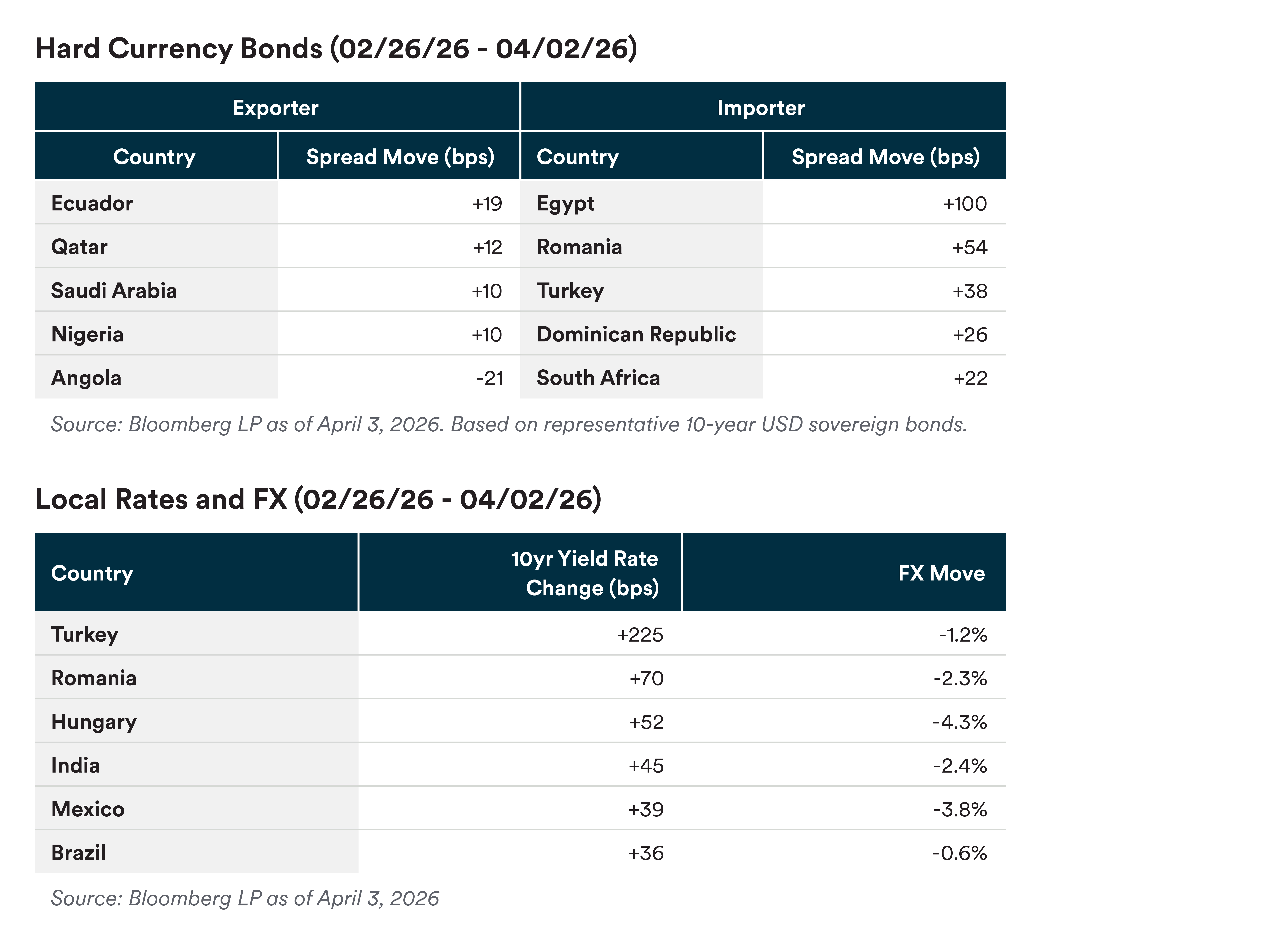
The Middle East is at the epicenter of the conflict and faces the most acute risks. Within the GCC, vulnerability varies significantly based on sovereign wealth fund buffers and the ability to bypass the Strait of Hormuz. Qatar, Kuwait, and the UAE face the greatest risk to their exports, but also possess substantial buffers that provide insulation, while Bahrain remains highly vulnerable without external support.
Saudi Arabia and the UAE benefit from pipeline infrastructure that partially mitigates export disruption risks, though geopolitical exposure remains elevated. Iraq is particularly exposed given its reliance on the Strait and limited storage capacity, raising risks of prolonged production shutdowns and domestic power shortages.
Outside the GCC, Egypt and Lebanon are among the most exposed sovereigns due to energy dependence, capital outflows, and limited buffers. In Africa, oil exporters such as Nigeria and Angola benefit from higher prices, while importers including Kenya and South Africa face inflationary pressures, tighter financial conditions, and rising food security risks driven by higher fertilizer costs.
Asia is significantly exposed to second‑round spillovers from the conflict given its reliance on imported energy and key trade routes, including the Strait of Hormuz. Higher oil and gas prices feed quickly into inflation across much of the region, pressuring current accounts and fiscal balances as governments attempt to smooth domestic fuel prices.
Countries such as India, Indonesia, and the Philippines are particularly vulnerable due to relatively small strategic reserves, weaker external positions, and limited fiscal space. Inflation risks are compounded by food and fertilizer costs, raising the likelihood of policy tradeoffs between growth support and currency stability.
By contrast, Malaysia and Australia benefit as net energy exporters, while North and Northeast Asia including Japan, Korea, and Taiwan are better positioned to manage near‑term shocks due to sizable strategic reserves despite high import dependence. China remains an outlier, supported by diversified energy sourcing, large reserves, and a lower oil share in its energy mix, allowing policymakers greater flexibility to prioritize growth.
For Central and Eastern Europe, a prolonged conflict is a net negative through higher inflation and weaker growth, though the region is structurally better positioned than during the 2022 energy shock. Energy diversification, positive real policy rates, and improved external balances provide greater resilience.
Hungary remains among the most exposed due to its energy mix and reliance on imported gas, while Romania’s relatively stronger energy position is offset by a more energy‑sensitive CPI basket. Central banks may adopt a more cautious stance, but the threshold for renewed tightening is materially higher than in previous cycles.
In contrast, CIS commodity exporters such as Kazakhstan and Azerbaijan are clear beneficiaries of a long‑war scenario, with higher oil prices strengthening fiscal revenues, external balances, and growth prospects. Uzbekistan’s gold exports provide a partial buffer, while Armenia and Georgia remain more exposed given import dependence and regional trade disruptions.
Latin America is less directly exposed to the conflict, but outcomes vary widely across the region. The dominant transmission channel is persistently higher oil and refined product prices, with macro impacts shaped by whether governments pass through higher costs or absorb them via subsidies and tax relief.
Net exporters such as Brazil, Argentina, and Ecuador benefit from improved terms of trade and stronger fiscal revenues, although inflation pressures may constrain monetary easing cycles. In Brazil, higher oil revenues provide scope to mitigate fuel‑driven inflation, while Argentina’s structurally improved energy balance supports the external account despite ongoing price‑management challenges.
Net importers including Chile, Peru, Mexico, and Colombia face negative terms‑of‑trade shocks, rising inflation, and higher fiscal costs from fuel stabilization mechanisms. Even where strong commodity exports offer partial offsets, policy tradeoffs intensify, complicating fiscal consolidation and monetary normalization.
For Central America, the Caribbean, and frontier markets, persistently higher energy prices represent a significant macro shock. Most countries in this universe are net energy importers with limited fiscal and external buffers, amplifying balance‑of‑payments pressures, inflation, and external financing risks.
Energy and commodity exporters including Venezuela, Trinidad and Tobago, Ghana, and Suriname are relative beneficiaries, as higher prices support export receipts and fiscal revenues. However, sanctions, operational constraints, and domestic price‑smoothing policies limit upside in some cases.
By contrast, high‑deficit importers such as Pakistan, Sri Lanka, Zambia, and several Caribbean economies face a sharp deterioration in macro dynamics, particularly where IMF program implementation coincides with tighter global financial conditions.
From a portfolio perspective, a prolonged Iran conflict reinforces the importance of sovereign differentiation across emerging markets. Energy exporters with strong external balances, fiscal buffers, and credible policy frameworks are better positioned to navigate a higher‑price environment, while energy importers with limited reserves and constrained fiscal space face rising macro, inflation, and financing risks. Selectivity remains critical, with a continued focus on balance‑sheet strength, policy credibility, and the ability to absorb sustained external shocks without destabilizing currencies or domestic financial conditions.
Heightened geopolitical uncertainty also underscores the importance of portfolio flexibility and liquidity management. While geopolitical shocks can drive short‑term volatility and risk‑off sentiment, they have historically created attractive entry points across EM sovereign markets, particularly where price dislocations outpace changes in underlying fundamentals. In this environment, maintaining adequate liquidity and dry powder remains key, alongside disciplined position sizing and risk management as markets adjust to a more protracted conflict backdrop.
Disclosure
MetLife Investment Management ("MIM"), which includes PineBridge Investments, is MetLife, Inc.'s institutional investment management business. MIM is a group of international companies that provides investment advice and markets asset management products and services to clients around the world. The various global teams referenced in this document, including portfolio managers, research analysts and traders are employed by the various legal entities that comprise MIM.
All investments involve risk, including possible loss of principal; no guarantee is made that investments will be profitable. This document is solely for informational purposes and does not constitute a recommendation regarding any investments or the provision of any investment advice, or constitute or form part of any advertisement of, offer for sale or subscription of, solicitation or invitation of any offer or recommendation to purchase or subscribe for any securities or investment advisory services. The views expressed herein are solely those of MIM and do not necessarily reflect, nor are they necessarily consistent with, the views held by, or the forecasts utilized by, the entities within the MetLife enterprise that provide insurance products, annuities and employee benefit programs. The information and opinions presented or contained in this document are provided as of the date it was written. It should be understood that subsequent developments may materially affect the information contained in this document, which none of MIM, its affiliates, advisors or representatives are under an obligation to update, revise or affirm. It is not MIM’s intention to provide, and you may not rely on this document as providing, a recommendation with respect to any particular investment strategy or investment. Affiliates of MIM may perform services for, solicit business from, hold long or short positions in, or otherwise be interested in the investments (including derivatives) of any company mentioned herein. Views may be based on third-party data that has not been independently verified. MIM does not approve of or endorse any republication of this material. This document may contain forward-looking statements, as well as predictions, projections and forecasts of the economy or economic trends of the markets, which are not necessarily indicative of the future. Any or all forward-looking statements, as well as those included in any other material discussed at the presentation, may turn out to be wrong.
The various global teams referenced in this document, including portfolio managers, research analysts and traders are employed by the various legal entities that comprise MIM.
All investments involve risks including the potential for loss of principle and past performance does not guarantee similar future results.
For investors in the U.S: This document is communicated by MetLife Investment Management, LLC (MIM, LLC), a U.S. Securities and Exchange Commission (SEC) registered investment adviser. Registration with the SEC does not imply a certain level of skill or that the SEC has endorsed the investment adviser.
For investors in the UK: This document is being distributed by MetLife Investment Management Limited (“MIML”), authorised and regulated by the UK Financial Conduct Authority (FCA reference number 623761), registered address One Angel Lane 8th Floor London EC4R 3AB United Kingdom. This document is approved by MIML as a financial promotion for distribution in the UK. This document is only intended for, and may only be distributed to, investors in the UK who qualify as a “professional client” as defined under the Markets in Financial Instruments Directive (2014/65/EU), as per the retained EU law version of the same in the UK.
For investors in the Middle East: This document is directed at and intended for institutional investors (as such term is defined in the various jurisdictions) only. The recipient of this document acknowledges that (1) no regulator or governmental authority in the Gulf Cooperation Council (“GCC”) or the Middle East has reviewed or approved this document or the substance contained within it, (2) this document is not for general circulation in the GCC or the Middle East and is provided on a confidential basis to the addressee only, (3) MetLife Investment Management is not licensed or regulated by any regulatory or governmental authority in the Middle East or the GCC, and (4) this document does not constitute or form part of any investment advice or solicitation of investment products in the GCC or Middle East or in any jurisdiction in which the provision of investment advice or any solicitation would be unlawful under the securities laws of such jurisdiction (and this document is therefore not construed as such).
For investors in Japan: This document is being distributed by MetLife Investment Management Japan, Ltd. (“MIM JAPAN”), a registered Financial Instruments Business Operator (“FIBO”) conducting Investment Advisory Business, Investment Management Business and Type II Financial Instruments Business under the registration entry “Director General of the Kanto Local Finance Bureau (Financial Instruments Business Operator) No. 2414” pursuant to the Financial Instruments and Exchange Act of Japan (“FIEA”), and a regular member of the Japan Investment Advisers Association and the Type II Financial Instruments Firms Association of Japan. In its capacity as a discretionary investment manager registered under the FIEA, MIM JAPAN provides investment management services and also sub-delegates a part of its investment management authority to other foreign investment management entities within MIM in accordance with the FIEA. This document is only being provided to investors who are general employees’ pension fund based in Japan, business owners who implement defined benefit corporate pension, etc. and Qualified Institutional Investors domiciled in Japan. It is the responsibility of each prospective investor to satisfy themselves as to full compliance with the applicable laws and regulations of any relevant territory, including obtaining any requisite governmental or other consent and observing any other formality presented in such territory. As fees to be borne by investors vary depending upon circumstances such as products, services, investment period and market conditions, the total amount nor the calculation methods cannot be disclosed in advance. All investments involve risks including the potential for loss of principle and past performance does not guarantee similar future results. Investors should obtain and read the prospectus and/or document set forth in Article 37-3 of Financial Instruments and Exchange Act carefully before making the investments.
For Investors in Hong Kong S.A.R.: This document is being distributed by MetLife Investments Asia Limited (“MIAL”), licensed by the Securities and Futures Commission (“SFC”) for Type 1 (dealing in securities), Type 4 (advising on securities) and Type 9 (asset management) regulated activities in Hong Kong S.A.R. This document is intended for professional investors as defined in the Schedule 1 to the SFO and the Securities and Futures (Professional Investor) Rules only. Unless otherwise stated, none of the authors of this article, interviewees or referenced individuals are licensed by the SFC to carry on regulated activities in Hong Kong S.A.R. The information contained in this document is for information purposes only and it has not been reviewed by the Securities and Futures Commission.
For investors in Australia: This information is distributed by MIM LLC and is intended for “wholesale clients” as defined in section 761G of the Corporations Act 2001 (Cth) (the Act). MIM LLC exempt from the requirement to hold an Australian financial services license under the Act in respect of the financial services it provides to Australian clients. MIM LLC is regulated by the SEC under US law, which is different from Australian law.
For investors in the EEA: For investors in the EEA, this document is being distributed by MetLife Investment Management Europe Limited (“MIMEL”), authorised and regulated by the Central Bank of Ireland (registered number: C451684), registered address 20 on Hatch, Lower Hatch Street, Dublin 2, Ireland. This document is approved by MIMEL as marketing communications for the purposes of the EU Directive 2014/65/EU on markets in financial instruments (“MiFID II”). Where MIMEL does not have an applicable cross-border licence, this document is only intended for, and may only be distributed on request to, investors in the EEA who qualify as a “professional client” as defined under MiFID II, as implemented in the relevant EEA jurisdiction. The investment strategies described herein are directly managed by delegate investment manager affiliates of MIMEL. Unless otherwise stated, none of the authors of this article, interviewees or referenced individuals are directly contracted with MIMEL or are regulated in Ireland. Unless otherwise stated, any industry awards referenced herein relate to the awards of affiliates of MIMEL and not to awards of MIMEL.