Against a backdrop of moderating growth and broadly stable credit fundamentals, a new “90/10 rule” is emerging in the leveraged finance markets in 2026. Essentially, we see a distinct split between the roughly 90% of issuers that are stable, performing well and may have a place in investors’ portfolios — and the remaining 10% — primarily highly leveraged credits that may be subject to complex restructurings and legal complications, such as LMEs, which are best avoided at prices anywhere near par.
In the top 90%, we continue to find attractive opportunities in both the bank loan and high yield markets, despite our view that both are fairly valued overall. In CLOs, the technical picture remains supportive and we find return potential relatively attractive, though tight valuations may argue for a marginally more defensive stance.
The lower 10% of assets has been demonstrably problematic for the past couple of years, with poor recovery prospects, significant downside risk, and a strong tendency to drag down overall portfolio performance. The emergence of liability management as a mainline tool, primarily utilized by aggressive issuers and their private equity sponsors, has complicated the reality for creditors in this segment of the market. Price declines due to industry news or an earnings miss for an overleveraged issuer now lead to LME fears, causing many market participants to simply abandon the issuer.

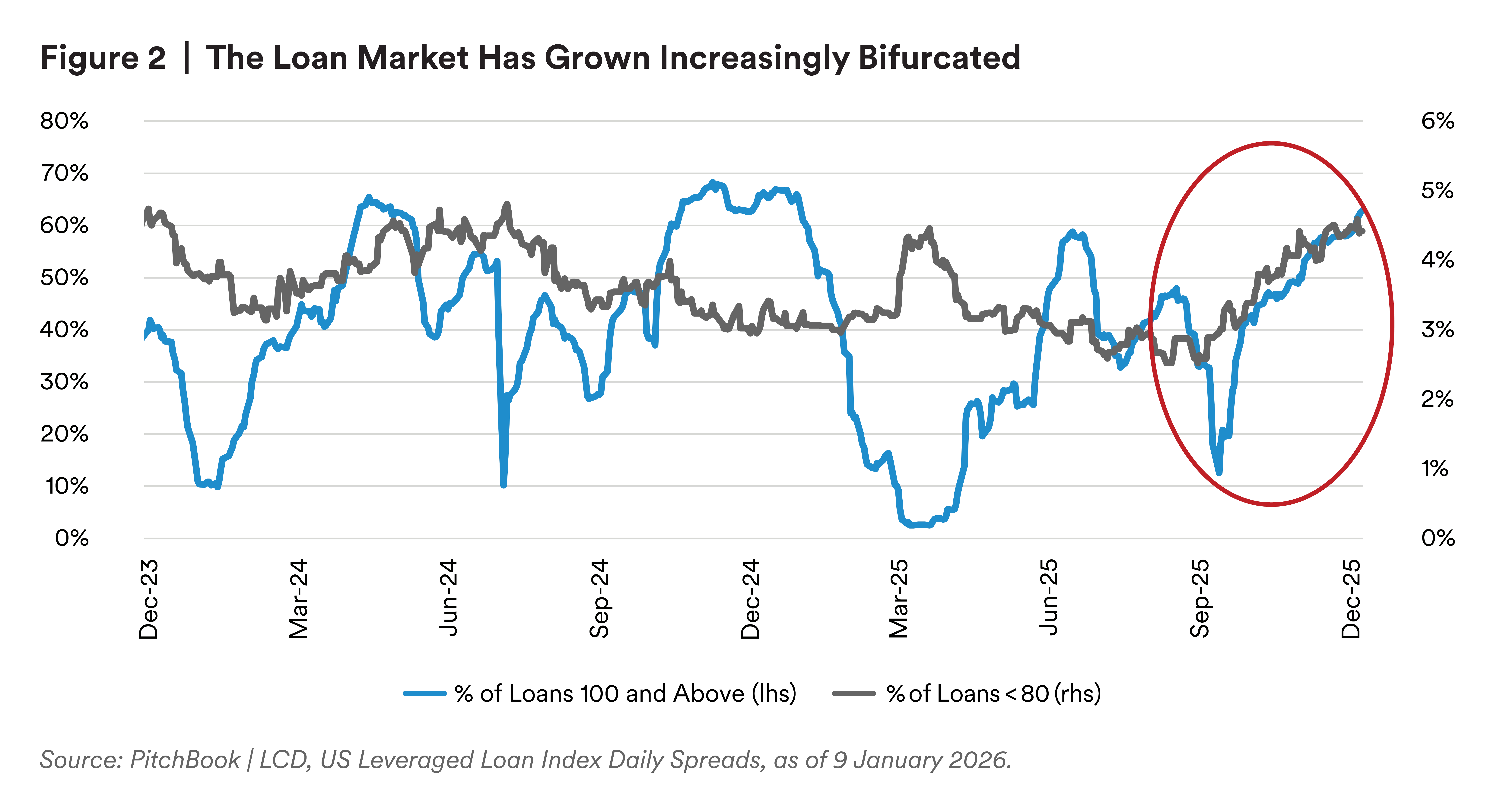
In the loan market, for instance, as the first set of charts below demonstrate, the more volatile loans in the market were more likely to see prices drop than rise in the past two years, a reversal of the dynamic in 2023; and once prices fall, they are far less likely to recover. This has led to an increased bifurcation between performing and distressed loans, as shown in the line chart further below.
This dynamic can make tail risk more challenging to manage and reinforces the importance of careful credit selection for all leveraged finance asset classes. Buying at a discount, with the hope that the upside potential would pan out, has often not turned out well.
In the current tight spread environment, the key to performance in 2026 will be in successfully discerning opportunities among issuers in the top 90-ish percent through careful credit selection while avoiding the stressed minority when priced only to offer incremental yield pickup.
Leveraged finance investing this year is framed by a macro environment of moderating economic growth on a base of strong credit fundamentals, with no signs of an imminent blowup in the credit cycle. The most recent earnings season has also been positive overall for issuers, though dispersion at the sector level has been sharp. Energy and retail companies, for instance, have beaten low expectations, with more companies raising than lowering guidance, while the chemicals sector is facing headwinds from weak global demand and significant overcapacity.
A key factor we continue to watch is the influence of artificial intelligence (AI) on companies — particularly how AI is driving capital expenditures in some sectors, such as independent power producers and telecoms — along with the impact of a pivot in Big Tech funding of AI buildouts toward debt financing and away from a traditional reliance on internal cash flows.
The leveraged finance universe tends to include later-stage companies for which AI may be more of a competitive threat than a benefit, though its impact differs among asset classes. In high yield, AI has driven financing needs, particularly in data centers and technology infrastructure, creating opportunities. In loans, on the other hand, AI has served as more of disruptor to existing businesses, posing long-term threats rather than immediate financing opportunities.
Overall, we expect positive, carry-based total returns for high yield bonds in 2026 (but muted excess returns) and believe investors are generally being compensated adequately for credit risk amid moderate default expectations, with valuations fair overall.In line with our broader “90/10” view, we regard the BB and B rated segments as the “sweet spot” for high yield investors and are narrowing exposure to lower-quality debt. We believe default risk remains low in aggregate and is concentrated in select companies and industries facing secular or structural pressures. We are becoming more cautious on issuers tied to lower-income consumers, which may experience more pressure in the current K-shaped economy.
The high yield market currently has a higher proportion of BB rated credits than it has historically, which influences spread levels. The triple-C segment, historically a source of excess returns, has underperformed in recent years, reflecting structural changes and legal challenges among some distressed credits. Moreover, CCC issuance accounted for just 3% of 2025 supply, the lowest share in more than two decades.1 While we expect the broader market to remain stable, with potential for spread tightening in the higher-quality segments, the lower-rated credits remain a concern.
High yield continues to offer attractive risk-adjusted yields relative to equities, where price/earnings ratios remain elevated, volatility is likely to persist, and earnings growth and capital expenditures are concentrated in a small cohort of companies.
We believe that while high yield bond valuations are fair overall, selective opportunities will continue to arise for active investors in 2026.
While loans underperformed other fixed-income assets in 2025 due to the lack of yield curve benefit, our expectation is that loans could be among the top fixed-income assets once again in 2026.
Economic conditions should continue to support loan issuer fundamentals in the coming months, as markets digest inflation and labor market data. However, we expect persistent episodes of volatility that skew toward issuers with weaker credit profiles or those feeling pressure from AI disruption, along with sectors facing broader economic headwinds, such as autos and chemicals.
The start of the year has also highlighted renewed headline risk related to government policy, with signs that the Trump administration may target certain sectors via the bully pulpit — including healthcare and financials — to signal efforts to address affordability ahead of the midterm elections. If so, we could see some issuers from these sectors shift into the lower 10% of underperforming credits.
That being said, healthy fundamentals and limited maturities over the next two years should limit distress within the broader loan market. Indeed, measures of distressed activity, including payment defaults and LMEs, trended lower through the fourth quarter of 2025. However, the percentage of the loan market trading below 80, a common measure of distress, increased during the same period, which suggests this trend may flatline. While loan portfolios have seen some spread tightening, this has been largely repricing-driven and is a result of strong loan technicals, in addition to good credit performance.
The market anticipates increased issuance driven by mergers and acquisitions this year, which may act as a catalyst for some spread widening. Overall, however, we expect a continuation of current market dynamics, barring unexpected economic developments.
In such a market, we believe that relative outperformance for loan managers, as with high yield, will be driven more by avoiding credits headed for distressed territory than by picking those that merely appear cheap. However, if loan spreads were to widen more broadly — for instance, as a result of severely negative sentiment related to the job market or consumer health — we would expect increased opportunities for alpha via credit selection.
As with other areas of leveraged finance, the key in 2026 will be in discerning the wheat from the chaff.
In European loans and high yield, third-quarter reporting has shown that issuer fundamentals remain stable as a whole, and we’re starting to see improvements in interest and fixed charge coverage ratios as ECB rate cuts start filtering through. However, pockets of weakness remain across the chemicals and building materials sectors, along with some company-specific risks. Despite this idiosyncratic volatility, we expect the broader market to tick along steadily unless macro or earnings data materially weaken. Given limited refinancing pressure, with only about €9 billion of loans coming due this year and next,2 we expect default rates to remain contained overall.
We believe CLO tranches may offer attractive total return potential relative to other equivalently rated fixed income assets as we enter 2026, and the technical picture appears supportive: ETF and institutional demand are both strong, and redemption and amortization volumes remain high. Yet while risks seem balanced, tight valuations may argue for an incrementally more defensive stance.
We view the market this year as favoring CLO managers who avoid excessive concentration and rather focus on credit selection to mitigate downside risks. In current market conditions, we believe CLO refinancings and resets may be preferable to primary market transactions because their performance and management history offer a potentially better view into the risk/reward balance.
Refi/reset activity for US CLOs backed by broadly syndicated loans set an annual record in 2025, and given current spread levels, the pace looks set to continue this year. Roughly $422 billion (notional value) of US CLOs will exit their non-call periods in 2026, $330 billion of which are in-the-money at a 130 basis point AAA spread; this is on top of $131 billion that are already out of the non-call period and in the money.3
In sum, we view a nimble and robust bottom-up approach to security selection as paramount in 2026 given the dispersion in the loan market, in which certain CLO portfolios holding weaker credits may eventually experience impairments to the lowest-rated debt tranches – which could result in attractive opportunities more broadly to move down the capital stack.
Our outlook for leveraged finance in 2026 centers on balancing risk and opportunity in a market characterized by strong credit metrics but also structural challenges, especially in the lower-rated segments. Avoiding the riskiest credits, especially those in the triple-C category and those exposed to LME risks, has been crucial to performance in recent years and will remain paramount.
Recent geopolitical developments and renewed attacks on Fed independence did not trigger a significant immediate market reaction, but they highlight the presence of underlying risks that can quickly translate into market volatility.
While concentrated high-conviction portfolios can yield strong results in favorable years, they tend to underperform during more challenging periods. Diversification and careful selection of credits, focusing on vintage years and portfolios with lower risk profiles, will be strategically critical.
Successful leveraged finance investing increasingly depends on expert credit selection – and with our 90/10 guidance at the fore, we will take as much care in 2026 in avoiding the losers as in picking the winners.
For more insights into the trends moving markets in the coming year, see our 2026 Investment Outlook.
Endnotes
1 Source: Bank of America Research as of 30 November 2025.
2 Source: Pitchbook as of 2 January 2026.
3 J.P. Morgan, “CLO 2026 Outlook,” as of 25 November 2025.
Disclaimer
This material is intended solely for Institutional Investors, Qualified Investors and Professional Investors. This analysis is not intended for distribution with Retail Investors.
MetLife Investment Management (MIM), which includes PineBridge Investments, is MetLife Inc.’s institutional investment management business. MIM is a group of international companies that provides investment advice and markets asset management products and services to clients around the world.
This document is solely for informational purposes and does not constitute a recommendation regarding any investments or the provision of any investment advice, or constitute or form part of any advertisement of, offer for sale or subscription of, solicitation or invitation of any offer or recommendation to purchase or subscribe for any securities or investment advisory services. The views expressed herein are solely those of MIM and do not necessarily reflect, nor are they necessarily consistent with, the views held by, or the forecasts utilized by, the entities within the MetLife enterprise that provide insurance products, annuities and employee benefit programs. The information and opinions presented or contained in this document are provided as of the date it was written. It should be understood that subsequent developments may materially affect the information contained in this document, which none of MIM, its affiliates, advisors or representatives are under an obligation to update, revise or affirm. It is not MIM’s intention to provide, and you may not rely on this document as providing, a recommendation with respect to any particular investment strategy or investment. Affiliates of MIM may perform services for, solicit business from, hold long or short positions in, or otherwise be interested in the investments (including derivatives) of any company mentioned herein. This document may contain forward-looking statements, as well as predictions, projections and forecasts of the economy or economic trends of the markets, which are not necessarily indicative of the future. Any or all forward-looking statements, as well as those included in any other material discussed at the presentation, may turn out to be wrong.
The various global teams referenced in this document, including portfolio managers, research analysts and traders are employed by the various legal entities that comprise MIM.
All investments involve risks including the potential for loss of principle and past performance does not guarantee similar future results.
For investors the U.S.: This document is communicated by MetLife Investment Management, LLC (MIM, LLC), a U.S. Securities and Exchange Commission (SEC) registered investment adviser. Registration with the SEC does not imply a certain level of skill or that the SEC has endorsed the investment adviser.
For investors in the UK: This document is being distributed by MetLife Investment Management Limited (“MIML”), authorised and regulated by the UK Financial Conduct Authority (FCA reference number 623761), registered address One Angel Lane 8th Floor London EC4R 3AB United Kingdom. This document is approved by MIML as a financial promotion for distribution in the UK. This document is only intended for, and may only be distributed to, investors in the UK who qualify as a "professional client" as defined under the Markets in Financial Instruments Directive (2014/65/EU), as per the retained EU law version of the same in the UK.
For investors in the Middle East: This document is directed at and intended for institutional investors (as such term is defined in the various jurisdictions) only. The recipient of this document acknowledges that (1) no regulator or governmental authority in the Gulf Cooperation Council (“GCC”) or the Middle East has reviewed or approved this document or the substance contained within it, (2) this document is not for general circulation in the GCC or the Middle East and is provided on a confidential basis to the addressee only, (3) MetLife Investment Management is not licensed or regulated by any regulatory or governmental authority in the Middle East or the GCC, and (4) this document does not constitute or form part of any investment advice or solicitation of investment products in the GCC or Middle East or in any jurisdiction in which the provision of investment advice or any solicitation would be unlawful under the securities laws of such jurisdiction (and this document is therefore not construed as such).
For investors in Japan: This document is being distributed by MetLife Investment Management Japan, Ltd. (“MIM JAPAN”), a registered Financial Instruments Business Operator (“FIBO”) conducting Investment Advisory Business, Investment Management Business and Type II Financial Instruments Business under the registration entry “Director General of the Kanto Local Finance Bureau (Financial Instruments Business Operator) No. 2414” pursuant to the Financial Instruments and Exchange Act of Japan (“FIEA”), and a regular member of the Japan Investment Advisers Association and the Type II Financial Instruments Firms Association of Japan. In its capacity as a discretionary investment manager registered under the FIEA, MIM JAPAN provides investment management services and also sub-delegates a part of its investment management authority to other foreign investment management entities within MIM in accordance with the FIEA. This document is only being provided to investors who are general employees' pension fund based in Japan, business owners who implement defined benefit corporate pension, etc. and Qualified Institutional Investors domiciled in Japan. It is the responsibility of each prospective investor to satisfy themselves as to full compliance with the applicable laws and regulations of any relevant territory, including obtaining any requisite governmental or other consent and observing any other formality presented in such territory. As fees to be borne by investors vary depending upon circumstances such as products, services, investment period and market conditions, the total amount nor the calculation methods cannot be disclosed in advance. All investments involve risks including the potential for loss of principle and past performance does not guarantee similar future results. Investors should obtain and read the prospectus and/or document set forth in Article 37-3 of Financial Instruments and Exchange Act carefully before making the investments.
For Investors in Hong Kong S.A.R.: This document is being distributed by MetLife Investments Asia Limited (“MIAL”), licensed by the Securities and Futures Commission (“SFC”) for Type 1 (dealing in securities), Type 4 (advising on securities) and Type 9 (asset management) regulated activities in Hong Kong S.A.R. This document is intended for professional investors as defined in the Schedule 1 to the SFO and the Securities and Futures (Professional Investor) Rules only. Unless otherwise stated, none of the authors of this article, interviewees or referenced individuals are licensed by the SFC to carry on regulated activities in Hong Kong S.A.R. The information contained in this document is for information purposes only and it has not been reviewed by the Securities and Futures Commission.
For investors in Australia: This information is distributed by MIM LLC and is intended for “wholesale clients” as defined in section 761G of the Corporations Act 2001 (Cth) (the Act). MIM LLC exempt from the requirement to hold an Australian financial services license under the Act in respect of the financial services it provides to Australian clients. MIM LLC is regulated by the SEC under US law, which is different from Australian law.
For investors in the EEA: This document is being distributed by MetLife Investment Management Europe Limited (“MIMEL”), authorised and regulated by the Central Bank of Ireland (registered number: C451684), registered address 20 on Hatch, Lower Hatch Street, Dublin 2, Ireland. This document is approved by MIMEL as marketing communications for the purposes of the EU Directive 2014/65/EU on markets in financial instruments (“MiFID II”). Where MIMEL does not have an applicable cross-border licence, this document is only intended for, and may only be distributed on request to, investors in the EEA who qualify as a “professional client” as defined under MiFID II, as implemented in the relevant EEA jurisdiction. The investment strategies described herein are directly managed by delegate investment manager affiliates of MIMEL. Unless otherwise stated, none of the authors of this article, interviewees or referenced individuals are directly contracted with MIMEL or are regulated in Ireland. Unless otherwise stated, any industry awards referenced herein relate to the awards of affiliates of MIMEL and not to awards of MIMEL.